
LC#31: Roast Universalism
On comedy as platform currency, and a new newsletter + book project.

Hello folks, it’s been a long time since my last post, and that one post has since fermented into a proper academic article, which I discuss later as the main event. It’s weird: I started this newsletter right after my PhD, during a full-blown pandemic, when my employment perspectives were at their bleakest and my faith in writing at its lowest. Basically, I just wanted to discuss stuff that I enjoyed writing about, in a way that was not academic and thus I could also enjoy in itself. I am very proud of the writing I’ve done here, but ironically the reason I haven’t been posting regularly for years now is the very ideas I have been exploring in some of the later posts (namely, the ones about the cultural impact of JRE) have now become central to my academic research as well. So, in bittersweet news (definitely more sweet than bitter, but not in terms of me writing more about comedy in this newsletter), I have some announcements to make. For the occasion, I am doing that through the usual link thing.

So, the “becoming platform” of Joe Rogan introduced in this paper (which actually germinated from an older post on this newsletter) developed into a book proposal and then a book contract. The book will not be about Rogan or comedy per se, but a broader range of figures and themes related to how (primarily masculine) collective identities change in the age of social media platforms.

Today’s link is then to this other newsletter I have created, where I will discuss book-related themes and updates. If you like how I write about comedy and are curious about my broader research, and the book, click the image above to subscribe. Otherwise, just stay subscribed to this one. I will keep posting, albeit sporadically :)


This is a bit of an unusual article, as it is more of a commentary on old stuff I’ve written as well as on this new paper of mine that’s just come out in First Monday. Since I hope you read the former and want you to read the latter, I will give you some context to fill in the gaps.
The last newsletter I sent from here was responding to what, at the time, felt like a big switch in the podcast culture I had been following for years. It was not surprising to see Rogan go for Trump over Biden (and then Kamala Harris), but all of a sudden a bunch of podcasting comedians were not only having Trump on, but also endorsing him openly. This was new, because the type of “roast universalism” I outlined in my other paper about JRE was always keen on maintaining a type of political neutrality, or at least ambiguity. In the paper, I compared the anti-cancel culture talk of podcasting comedians to the “information wants to be free” mantra of free culture activists and Internet infrastructure geeks, a sort of discursive equivalent to the material know-how of Christopher Kelty’s “recursive publics”, but significantly re-contextualised within the monetisation-driven, plug-and-play mentality of platformed content creation. In other words, podcasting comedians being obsessed with free speech, and their concern with the embodied particularities of identity politics messing with their business models, emerges as a sort of cultural renewal of the age-old idea that the Internet is immaterial, universal, and renders the clunkiness of government and partisan politics obsolete.
At the same time, the alignment of comedians like Andrew Schulz, Tim Dillon, Theo Von, and Rogan himself as a united, Trump-supporting partisan front aligned perfectly with the quick political turn of platform capitalists like Zuckerberg, Musk, Thiel, Andreessen, etc - all of whom did the rounds on JRE shortly after the 2024 election. From this perspective, my paper’s idea of “roast universalism” as an infrastructure-dependent ideology still held together - especially as the ambiguous centrism of podcasting comedians is now apparently creeping back into their narratives, as Trump keeps doing Trump and loses support in the process.
How has the Rogansphere changed over the past two years, then? How does its specific style of roast universalism speak to Trump’s talking points? And how have its publics reacted to the ideological shift that, undeniably, altered the public perception of these “speaking truth to power” professionals?
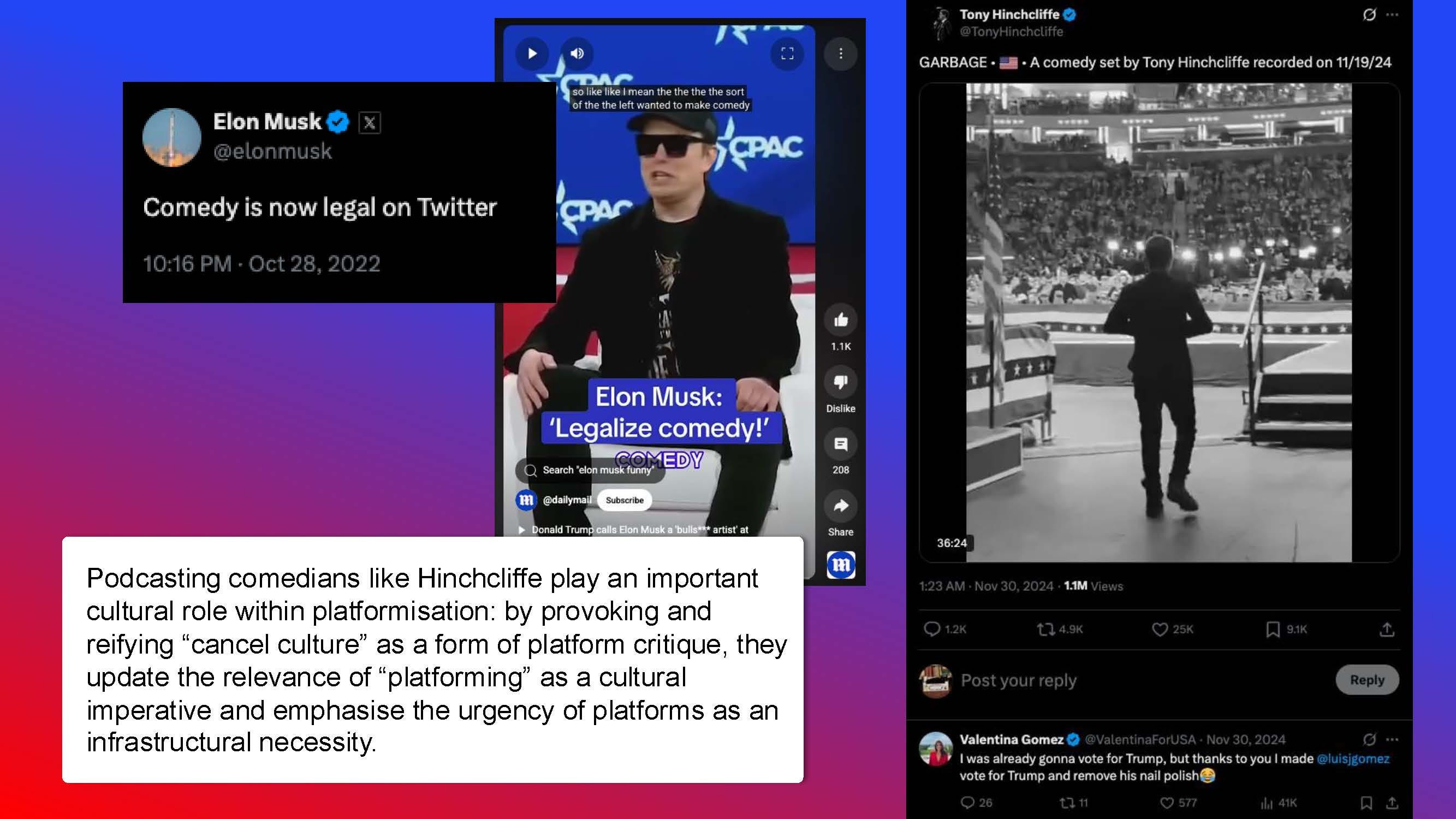
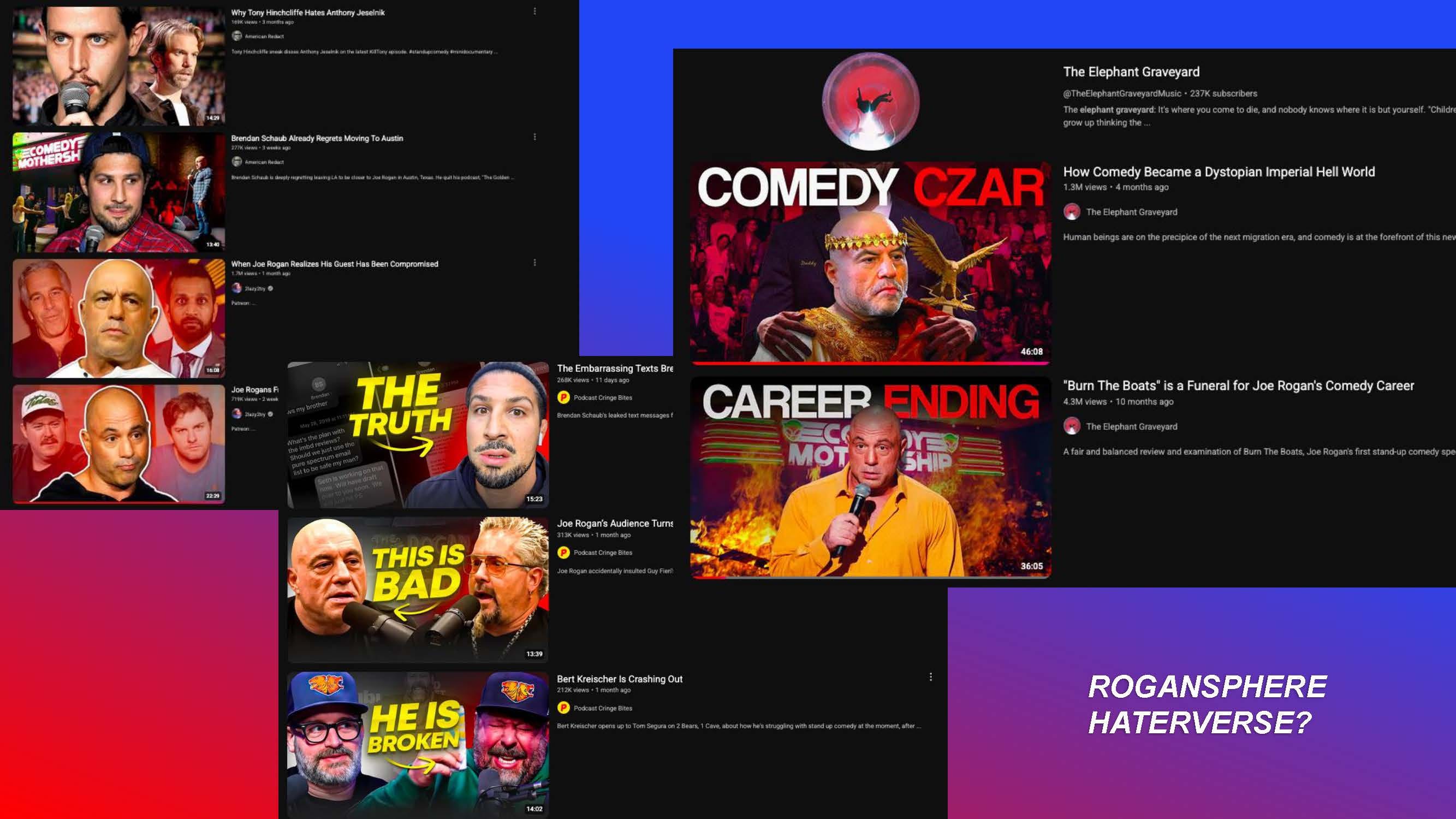
In the new paper, I explore these issues by discussing two main off-shoots of the Rogansphere: first, Tony Hinchcliffe’s persona as the creator of Kill Tony, with a detailed discussion of his “Garbage” special, which he published after a controversial appearance at a pre-election Trump rally; then, a constellation of YouTube creators that I’ve called the Rogan-Hatersphere, given their focus on Rogansphere-critical content and emphasis on his and his entourage’s political shift towards the Right, as well as alignment with the tech elite.
The point of the paper is to unpack how the negotiation of what comedy is, and how important, came to play a rather important role in a particular moment in the history of US politics and their tech industry. While this is a pretty specific case study, it informs one of the wider preoccupations of my book: how the meaning of Internet infrastructures like social media platforms hinges significantly also on collective identities that coalesce around quasi-mythical “cultural avatars” - e.g. the Comedian - that project attitudes and values onto new kinds of techno-political alliances. To put it in simpler terms: if the Internet is meant to be a technical infrastructure that works the same for everyone, under what conditions does an apparently de-politicised identity category (like the comedian) make a difference in how we understand it? What problems occur when this happens?
If I haven’t lost you yet, go read the paper, and subscribe to Becoming Platform :)